- ITIL Service Catalog Definition – What It Really Means
- Service Catalog in ITIL: Structure and Key Components
- ITIL Service Catalog Example: How It Looks in Real Life
- Benefits of Implementing an ITIL Service Catalog
- Best Practices for ITIL Service Catalog Implementation
- ITIL Service Catalog Software – Best Options to Use
- Comparison: Best ITIL Service Catalog Software by Use Case
- Implementation Workflow Using the ITIL Service Catalog
- Free vs Paid ITIL Service Catalog Resources
- Conclusion: Build a Strong ITIL Service Catalog for Better ITSM
IT teams often struggle with one simple question from users: “What services do you actually provide?” When there is no clarity, support tickets pile up, users get frustrated, and service quality drops. That’s where the ITIL Service Catalog becomes a game changer.
It works as a clear, user-friendly library of all active IT services, who owns them, how they are delivered, and what users can request easily. A strong ITIL Service Catalog improves user experience, supports better decision-making, reduces confusion, and builds trust between IT and the business. And that’s exactly what this guide will help you understand—structure, benefits, examples, tools, and practical rollout steps.
ITIL Service Catalog Definition – What It Really Means
Let’s keep this simple.
ITIL Service Catalog Definition:
The ITIL Service Catalog is a structured, organized list of all live IT services available to users, with clear details about what each service does, who owns it, how to request it, and how it will be delivered.
Now, a quick clarity point, people often mix up:
- Service Catalog vs Service Portfolio
- Service Catalog: Only includes services currently live and available.
- Service Portfolio: Includes current services + services in development + services retired.
Also, the Service Catalog in ITIL includes:
- A business view (how users see services)
- A technical view (how IT manages and supports them internally)
This explanation aligns with ITIL 4 teaching principles that we deliver in our professional ITIL training programs. It ensures that teams don’t just understand definitions but know how to connect the Service Catalog with value delivery, user experience, and ITSM maturity.
Service Catalog in ITIL: Structure and Key Components
So, what really goes inside the Service Catalog in ITIL?
A good catalog is not just a long menu. It is structured, clear, and meaningful for users and IT teams. Here are the core elements that usually build a strong ITIL Service Catalog:
- Service Description: Clear explanation of what the service is and what the user will get.
- SLAs / SLTs: Expected service levels, response time, and fulfillment timelines.
- Availability & Performance: Service uptime, support windows, and reliability details.
- Pricing or Cost (If Applicable): Helpful in enterprise environments.
- Ownership: Who is responsible and accountable for the service?
- Request Models & Fulfillment Workflow: What happens after a user raises a request?
- Categorization of Services:
- Hardware services
- Software services
- Access & permissions
- Support services
A well-structured ITIL Service Catalog also connects with CMDB, incident management, and change management to keep everything aligned and controlled.
ITIL Service Catalog Example: How It Looks in Real Life
Let’s take a simple and relatable ITIL Service Catalog Example so it doesn’t feel theoretical.
Example: “New Employee Onboarding Bundle”
When a new employee joins, instead of raising 5–6 different requests, they get a bundled service such as:
- Laptop provisioning
- Email account creation
- Business application access
- Collaboration tools
- Initial training setup
This ITIL Service Catalog Example shows how:
- Bundles reduce multiple tickets
- IT reduces workload
- Users get faster fulfillment
- Experience becomes smoother and more professional
In our training sessions, we see this onboarding bundle example resonate the most with IT leaders and ITSM professionals. Many organizations adopt similar catalog structures after training because it simplifies workflows, improves fulfillment speed, and reduces user confusion in real operations.
Download: ITIL Service Catalog Templates Pack
Build a service catalog people actually use. Get ready-to-edit templates to define services, SLAs, workflows, and bundles without overcomplicating ITIL.
Benefits of Implementing an ITIL Service Catalog
Once organizations adopt a strong ITIL Service Catalog, the results are visible. Here are some clear benefits:
- Better Self-Service Adoption: Users know exactly what to request and how. Many organizations see a 30–50% ticket reduction when self-service improves.
- Clear Communication & Transparency: No confusion, no assumptions. Everyone understands what IT offers and what to expect.
- Improved Alignment with Business Needs: Services are documented based on real business outcomes, not random technical items.
- Supports KPI Tracking & Reporting: Easier to track fulfillment time, CSAT, SLA compliance, and performance.
- Enables Continual Improvement: With structured service data, teams can identify gaps and improve faster.
A well-built ITIL Service Catalog is not just documentation—it becomes the backbone of smarter service delivery.
Best Practices for ITIL Service Catalog Implementation
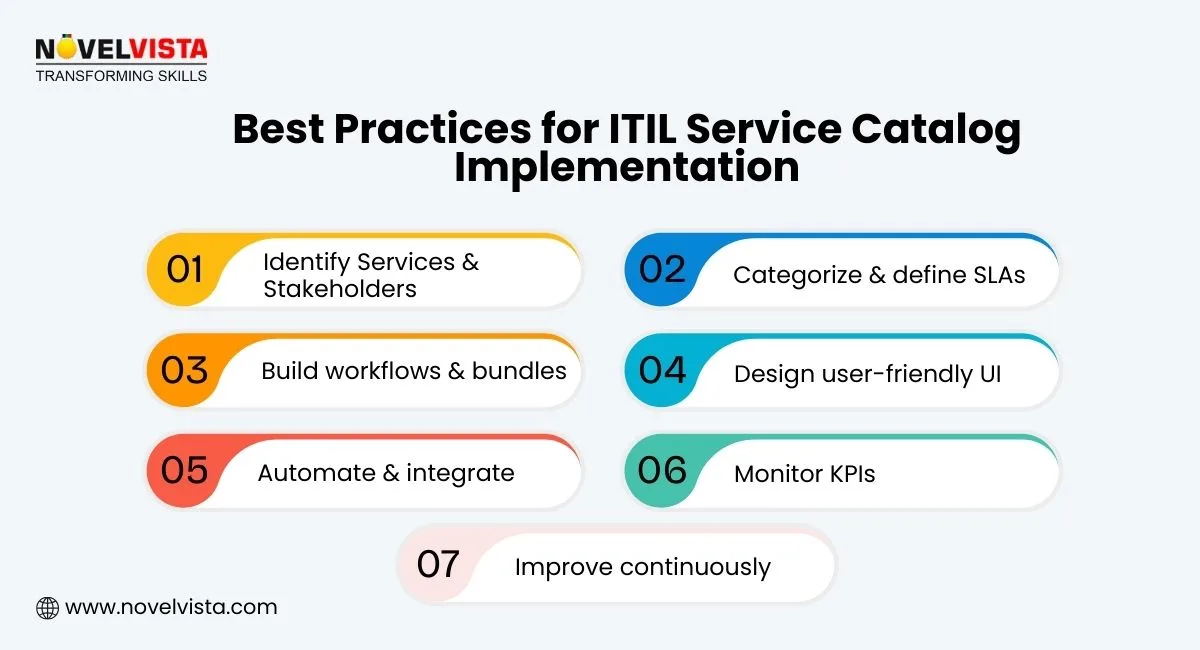
Teams often struggle not because the ITIL Service Catalog is complex, but because they try to do everything at once. A structured rollout approach works best. The following best practices reflect globally accepted ITIL guidance and are regularly used in our ITIL certification training to help professionals move from basic understanding to confident, practical implementation in their organizations.
A Practical Rollout Plan
- Identify services and stakeholders – Understand what services truly matter to users and who owns them
- Categorize services and define SLAs – Group services logically and explain expectations
- Build workflows and bundles – Make fulfillment simple, repeatable, and consistent
- Design a user-friendly UI – The catalog should feel easy, intuitive, and helpful
- Automate and integrate – Connect with CMDB, incident, change, and request workflows
- Monitor KPIs – Track fulfillment speed, complaints, breaches, and feedback
- Improve continuously – Review, refine, and expand gradually
A few golden rules:
- Keep language simple and business-friendly
- Don’t over-engineer — start small, prove value, then scale
- Assign ownership and governance to keep it updated
These best practices help the ITIL Service Catalog stay useful, relevant, and reliable.
ITIL Service Catalog Software – Best Options to Use
To make the Service Catalog in ITIL successful, the right platform matters. Good ITIL Service Catalog Software should make it easy to design, publish, manage, and track services.
Key Features You Should Expect
- Simple, intuitive service interface
- Strong automation and workflow capabilities
- Role-based access control
- Integration with CMDB and ITSM processes
- Reporting and analytics
- Scalability and flexibility
Leading ITIL Service Catalog Software Options
- ServiceNow – Powerful enterprise platform with deep automation
- ManageEngine – Strong ITSM suite with practical workflows
- Freshworks – Great for self-service and user experience
- Atlassian tools – Highly customizable and scalable
The right ITIL Service Catalog Software depends on your size, budget, and maturity level.
Comparison: Best ITIL Service Catalog Software by Use Case
Software Type |
Examples |
Key Strengths |
Cost Model |
Full ITSM Platforms |
ServiceNow, ManageEngine |
AI automation, CMDB integration, SLA workflows |
Subscription |
Lightweight Tools |
Freshworks |
Easy self-service, bundles, strong UI |
Freemium to Enterprise |
Customizable Solutions |
Atlassian |
Flexible workflows, scalable design |
Subscription |
This helps organizations choose the ITIL Service Catalog Software that truly fits their needs.
Implementation Workflow Using the ITIL Service Catalog
A structured implementation journey makes adoption smoother.
- Define scope and service objectives
- Build and structure your ITIL Service Catalog
- Deploy using the right ITIL Service Catalog Software
- Train users and stakeholders
- Monitor, measure, and optimize continuously
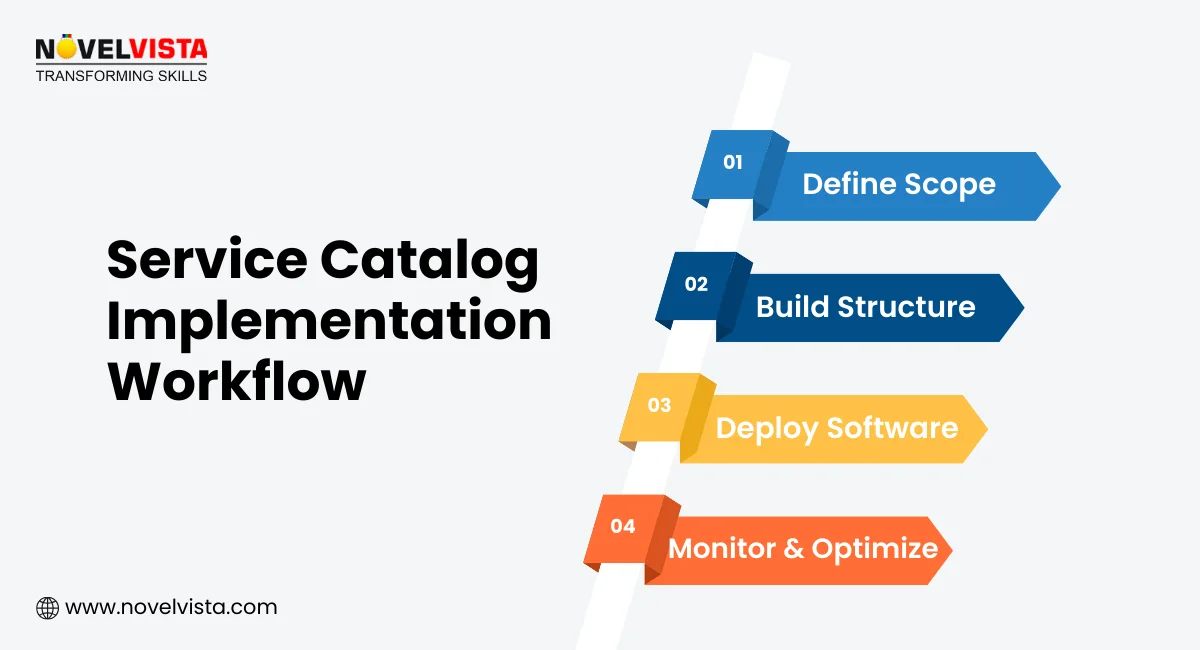
This keeps the ITIL Service Catalog practical instead of just theoretical documentation.
Free vs Paid ITIL Service Catalog Resources
Both free and paid options play a role depending on your maturity level.
Free Resources
- Basic catalog templates
- Sample service entries
- Checklists
Great for beginners or early-stage implementation.
Paid Resources
- Full ITIL catalog suites
- Workflow automation platforms
- Expert consulting and support
Perfect for organizations wanting serious scalability, automation, and governance.
Conclusion: Build a Strong ITIL Service Catalog for Better ITSM
The ITIL Service Catalog is no longer just a “nice to have”. It has become a core part of modern IT service delivery. When structured well, it improves user satisfaction, speeds up service fulfillment, reduces unnecessary tickets, and builds trust between IT and the business. A clear catalog creates clarity, control, and consistency — exactly what strong ITSM needs.
A strong ITIL Service Catalog is one of the most discussed success elements in our ITIL certification programs because it directly impacts user trust, IT credibility, and business alignment. When implemented with proper structure and ownership, it becomes a cornerstone of effective ITSM.

Next Step: Strengthen Your ITSM Skills with ITIL 4 Foundation
If you want to design better service experiences, manage services confidently, and understand how the ITIL Service Catalog fits into the bigger ITIL 4 framework, upgrading your knowledge is a smart move. NovelVista’s ITIL 4 Foundation Certification Training helps you understand ITIL concepts in a practical, real-world way, so you can apply them confidently in your organization. Learn with experts, build clarity, and strengthen your ITSM career path.
Frequently Asked Questions
Author Details

Course Related To This blog
ITIL4 Specialist Monitor Support and Fulfil Certification
ITIL4 Specialist Acquiring & Managing Cloud Services
ITIL 4 Specialist Sustainability in Digital & IT
ITIL® 4 Strategic Leader Digital And IT Strategy (DITS)
ITIL® 4 Specialist Drive Stakeholder Value
ITIL® 4 Specialist High Velocity IT
ITIL® 4 Strategist Direct, Plan & Improve
ITIL® 4 Specialist Create Deliver & Support
ITIL® 4 Foundation Certification
Confused About Certification?
Get Free Consultation Call