- Final Audit Review Readiness: What Auditors Should Confirm First
- Clause 4–6 Review: Context, Leadership, and Planning
- Clause 7–8 Review: Support and Operational Controls
- Clause 9–10 Review: Performance and Improvement
- Audit Planning Tools Every ISO 9001 Lead Auditor Uses
- Quality Audit Tips for Strong Evidence Collection
- Nonconformity Identification Using the ISO 9001 Lead Auditor Checklist
- Lead Auditor Focus: What Experienced Auditors Double-Check Before Closing
- Final Audit Review Before the Closing Meeting
- Audit Reporting and Follow-Up Best Practices
- Conclusion: Confidently Closing Your ISO 9001 Final Audit
Preparing for a final audit review can feel overwhelming, but having a structured ISO 9001 lead auditor checklist makes the process much smoother. This checklist ensures auditors systematically cover all Clauses 4–10, verify evidence, and assess real operational effectiveness, not just paperwork. Using it properly helps avoid last-minute surprises, improves audit confidence, and strengthens the credibility of your findings.
By following this guide, lead auditors can confidently handle certification audits, streamline their workflow, and ensure consistent results across multiple audit engagements.
Final Audit Review Readiness: What Auditors Should Confirm First
Before diving into individual clauses, auditors need to confirm overall readiness:
- Audit scope and certification boundaries: Verify that all organizational units, processes, and any exclusions are clearly documented and justified.
- Audit objectives and criteria alignment: Confirm that the audit plan aligns with ISO 9001 requirements, internal procedures, and customer or regulatory expectations.
- SMS (Quality Management System) readiness: Ensure Clauses 4–10 are fully addressed, with clear evidence for each, including interviews, process observations, and documented information.
- Resource availability: Check that personnel, tools, and documentation required for the audit are ready and accessible.
Proper readiness at this stage sets the tone for a thorough, efficient final audit review. Our experience shows that confirming readiness at the organizational level often prevents the majority of audit nonconformities. Lead auditors trained with this approach consistently report smoother audits because they align audit scope, objectives, and SMS coverage before examining individual clauses.
Clause 4–6 Review: Context, Leadership, and Planning
Clause 4 – Context of the Organization
- Internal and external issues: Verify that the organization has identified relevant internal challenges and external factors affecting its QMS.
- Interested parties and expectations: Ensure stakeholder requirements are documented and considered in QMS planning.
- Defined and justified QMS scope: Confirm the scope covers all relevant activities, with exclusions explained.
Clause 5 – Leadership
- Top management commitment: Check evidence of active leadership involvement, policy communication, and resource allocation.
- Quality policy awareness: Validate that staff understand and apply the quality policy in their work.
- Roles, responsibilities, and authorities: Confirm clarity of ownership for key processes and decision-making responsibilities.
From lead auditor workshops, we observe that evidence of top management engagement is one of the first areas auditors evaluate. Real audit success often hinges on visible leadership involvement, not just signed policies. This checklist emphasizes the practical assessment of leadership influence across processes.
Clause 6 – Planning
- Risk and opportunity identification: Ensure potential risks and improvement opportunities are documented, with actions assigned.
- Quality objectives and monitoring: Verify measurable objectives are defined and progress tracked effectively.
- Change management planning: Confirm that changes in processes or systems are planned, assessed, and controlled.
Quality audit tips: Focus on actual evidence of monitoring and implementation, not just documented intent. Interview leadership to validate ownership and accountability.
Clause 7–8 Review: Support and Operational Controls
Clause 7 – Support
- Competence and training records: Ensure employees have required skills, qualifications, and ongoing training evidence.
- Awareness programs: Verify that staff understand QMS objectives, policies, and their specific roles.
- Documented information control: Confirm controlled access, proper versioning, and retrieval of QMS documents and records.
Clause 8 – Operation
- Customer requirement review: Check procedures for receiving, reviewing, and communicating customer requirements.
- Operational planning and control: Verify processes are properly planned, resources allocated, and performance monitored.
- Control of nonconforming outputs: Ensure procedures for identifying, segregating, and correcting nonconformities are in place.
Final audit review focus: Use training matrices, document version control, and process walkthroughs to confirm evidence matches actual practice. Observing live operations adds confidence beyond paperwork.
Clause 9–10 Review: Performance and Improvement
Clause 9 – Performance Evaluation
- Monitoring and measurement data: Verify that relevant KPIs, metrics, and process performance indicators are recorded, analyzed, and reported.
- Customer satisfaction feedback: Check methods for gathering, analyzing, and acting on customer feedback to drive improvements.
- Internal audit results: Ensure internal audits are conducted as planned, with findings documented and followed up on.
- Management review minutes: Validate that leadership reviews QMS performance, sets objectives, and monitors progress against targets.
Clause 10 – Improvement
- Nonconformity handling: Confirm that nonconforming outputs are identified, documented, corrected, and monitored for effectiveness.
- Root cause analysis methods: Check that investigations go beyond symptoms to identify underlying causes.
- Effectiveness of corrective actions: Ensure that corrective actions are implemented, verified, and tracked to prevent recurrence.
Quality audit tips: Cross-verify documents, interviews, and actual practices. Focus on trends, patterns, and continual improvement rather than isolated incidents.
Audit Planning Tools Every ISO 9001 Lead Auditor Uses
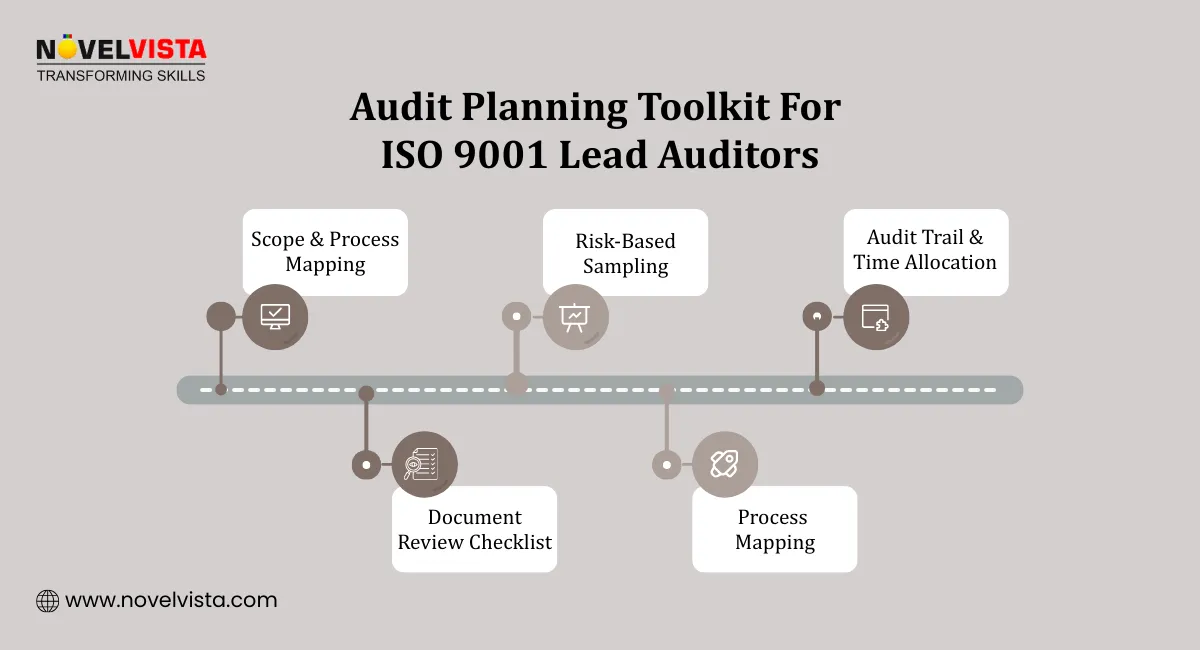
Effective auditors rely on structured audit planning tools to organize and optimize their work. These tools help ensure all audit objectives are met and evidence is adequately collected.
- Scope definition and process mapping: Identify all processes within the QMS and map them to relevant clauses. This ensures nothing is missed and that sampling is risk-based.
- Risk-based sampling techniques: Focus on high-risk processes or areas with past nonconformities. It helps prioritize efforts and verify critical controls during the final audit review.
- Audit trail and time allocation planning: Allocate time efficiently across sites, teams, and processes to avoid bottlenecks.
- Pre-audit document review checklist: Includes QMS manuals, policies, procedures, quality objectives, and records. This step ensures auditors are familiar with processes and have noted areas needing deeper observation.
Using these audit planning tools allows auditors to conduct a focused, evidence-driven review without overlooking critical areas.
Quality Audit Tips for Strong Evidence Collection
These audit tips are informed by professional ISO 9001 lead auditor training programs, which focus on evidence triangulation, matching documents, observations, and interviews, to evaluate consistency, compliance, and real operational performance.
- Interview techniques for process owners: Ask open-ended questions to verify understanding, responsibility, and real-life application of processes.
- Cross-verification: Match documents, observations, and interviews to confirm consistent process execution.
- Risk-based document and record sampling: Prioritize high-impact areas and critical processes during sampling.
- Observing real practices vs. written procedures: Always check that what is documented aligns with daily operations.
Using these quality audit tips ensures the final audit review reflects actual system performance, not just paperwork compliance.
Nonconformity Identification Using the ISO 9001 Lead Auditor Checklist
- Major nonconformities: Identify system-level failures or repeated process gaps that significantly impact QMS effectiveness.
- Minor nonconformities: Detect isolated or procedural deviations that do not compromise overall system performance but require correction.
- Observations: Note opportunities for improvement or best practice adoption.
- Writing clear statements: Link nonconformities to specific clauses for clarity and audit trail integrity.
A structured approach ensures findings are actionable, fair, and aligned with ISO 9001 requirements.
Discover the pitfalls auditors often encounter. Check out our comprehensive guide on Common ISO 9001 Nonconformities to learn how to identify, assess, and handle them effectively during audits.
Lead Auditor Focus: What Experienced Auditors Double-Check Before Closing
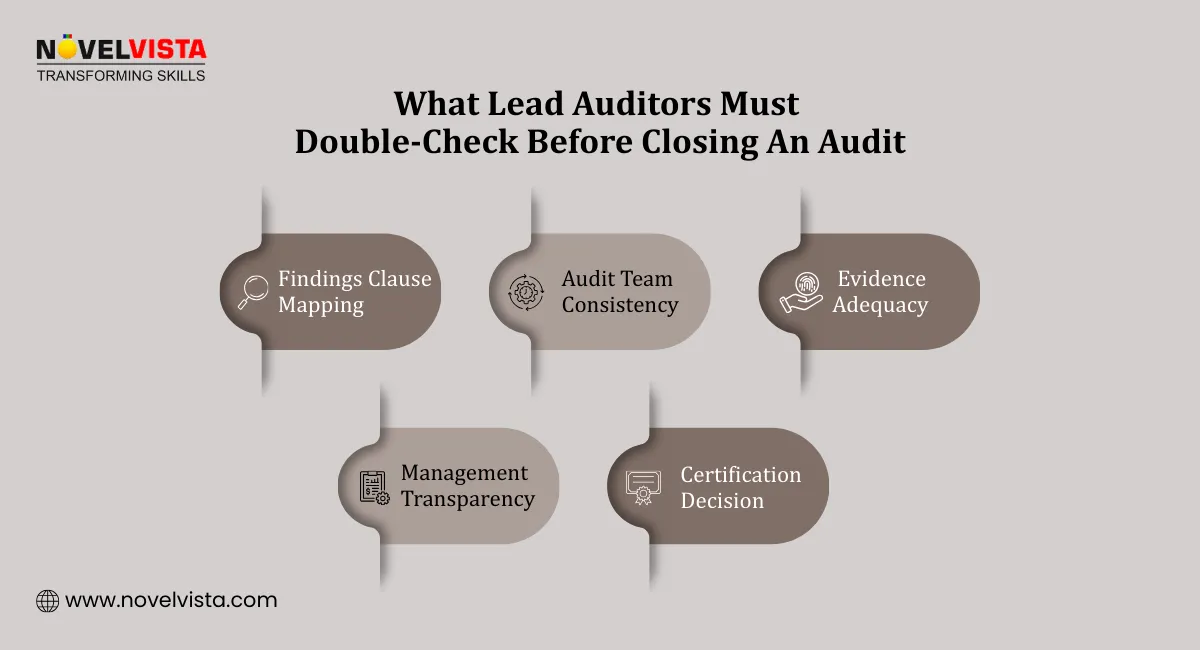
- Clause linkage of findings: Confirm every nonconformity clearly maps to the relevant ISO 9001 clause.
- Consistency across audit team observations: Ensure that all auditors reach a consensus on findings and severity ratings.
- Evidence adequacy for certification decisions: Validate that evidence supports each conclusion thoroughly.
- Review findings internally to avoid unexpected issues during auditor-client discussions.
This stage strengthens credibility and prepares the team for a smooth final audit review.
Final Audit Review Before the Closing Meeting
- Consolidating and categorizing findings: Organize observations by severity, clause, and department.
- Preparing the executive audit summary: Present a concise overview highlighting key results, nonconformities, and improvement opportunities.
- Validating audit conclusions internally: Ensure consistency between evidence, observations, and final ratings.
- Using digital audit planning tools: Leverage templates, checklists, and matrices to streamline documentation and reporting.
Structured preparation here helps auditors confidently close the audit with authority and professionalism.
Audit Reporting and Follow-Up Best Practices
- Clear and structured audit reports: Present findings in a readable, logical format.
- Findings presented by clause: Map nonconformities, minor observations, and suggestions to specific ISO 9001 clauses.
- Expectations for corrective action plans: Ensure organizations understand timelines, responsibilities, and verification methods.
- Follow-up verification and effectiveness review: Track closure of nonconformities and assess whether corrective actions achieve intended outcomes.
This approach reinforces organizational learning and continual improvement within the QMS.
Want to master ISO 9001 reporting? Explore our blog on ISO 9001 Report Writing to learn how to structure clear, compliant, and impactful audit reports that impress auditors and management alike.
Download The Pre-Audit Power Checklist Now
Stay audit-ready without last-minute panic.
Use this one-page checklist to organize documents,
evidence, and teams, so audits feel controlled, not chaotic.
Conclusion: Confidently Closing Your ISO 9001 Final Audit
A solid ISO 9001 lead auditor checklist, combined with careful planning, evidence collection, and review, is the key to a successful final audit review. Using structured tools, proven audit planning tools, and practical quality audit tips ensures audits are efficient, thorough, and credible. Lead auditors who follow this approach can confidently guide organizations through certification audits, minimize surprises, and drive long-term QMS maturity.
Following this checklist supports a transparent and structured audit approach. It aligns documentation, interviews, and observations with ISO 9001 requirements, promoting confidence in audit results while reinforcing continual improvement practices across the organization.
Next Step: Advance Your Skills with ISO 9001 Lead Auditor Certification
Take your auditing expertise to the next level with NovelVista’s ISO 9001 Lead Auditor Certification Training Course. Gain hands-on experience, practical audit techniques, and learn to conduct confident final audit reviews. This program equips you to assess QMS effectiveness, verify compliance across Clauses 4–10, and guide organizations toward continual improvement. Enroll today to enhance your career and lead successful ISO 9001 audits with confidence.

Frequently Asked Questions
Author Details

Course Related To This blog
ISO 9001:2015 Lead Auditor Training and Certification
Confused About Certification?
Get Free Consultation Call