What Does Tailoring PRINCE2 Really Mean?
Tailoring PRINCE2 means adjusting the PRINCE2 themes, processes, roles, documentation, and controls to fit the project environment, industry, complexity, and governance needs. PRINCE2 is intentionally flexible, encouraging teams to refine and resize components so the method stays practical rather than bureaucratic. It is not about removing structure, but about adapting responsibly—by reducing unnecessary documentation, simplifying processes, combining roles in small teams, scaling decision-making layers, adjusting reporting requirements, and modifying review frequency. The goal is to maintain strong governance while improving agility, clarity, and project efficiency.
Why Tailoring PRINCE2 Is Essential
Tailoring PRINCE2 is essential because no two projects are alike—whether it’s a software upgrade, a multi-year digital transformation, or a compliance-driven implementation—and PRINCE2 acknowledges this reality. Without tailoring, teams often face excessive documentation, slow decision-making, misalignment with organization culture, and rigid processes that create delays. By tailoring PRINCE2, organizations enable leaner processes, faster approvals, clearer communication, better risk control, and strong governance with lower complexity, helping maintain consistency while still responding effectively to varying project demands.
Download The Practical Guide to Tailoring PRINCE2
- Adapt PRINCE2 for any project
- Maintain governance without complexity
- Apply practical tailoring techniques
Principles for Tailoring PRINCE2 Without Losing Governance
Below are the key foundations you must preserve while tailoring the method effectively.
1. Clearly Define Project Objectives
Clear objectives are the foundation of effective tailoring. PRINCE2 emphasizes a strong business justification and shared understanding of outcomes. A tailored approach keeps project objectives aligned with stakeholder expectations while scaling processes and documentation. This reduces confusion, prevents scope creep, and provides clear direction throughout the project lifecycle.
2. Assess Project Complexity and Size
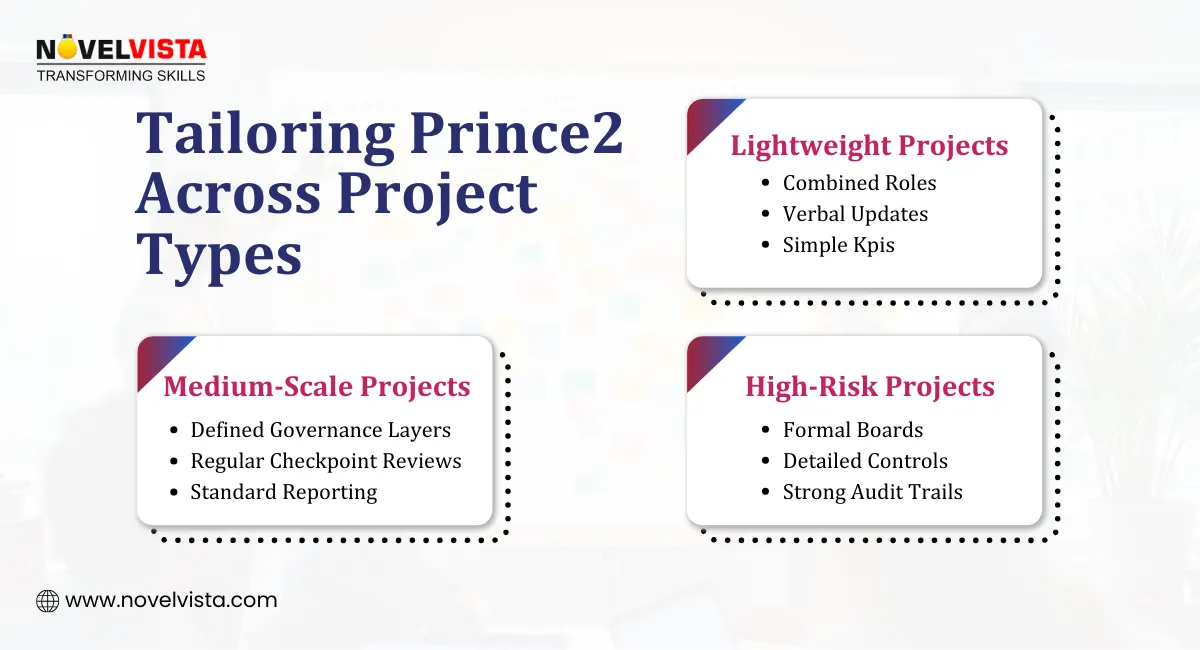
Project complexity and size directly influence how Tailoring PRINCE2 should be applied. Factors such as team size, project duration, risk exposure, dependencies, and technology requirements must be assessed. Smaller projects may use shorter reports, merged roles, and reduced documentation, while complex projects may require increased checkpoints, enhanced governance layers, and detailed plans. The goal is balance—simple enough to be usable, strong enough to provide control.
3. Determine Appropriate Governance & Decision-Making Structures
Governance is the backbone of PRINCE2 and must be scaled thoughtfully. Tailoring PRINCE2 allows you to adjust the size of the Project Board, refine decision pathways, clarify escalation tolerances, and strengthen or simplify reporting cycles. This ensures accountability remains intact even when processes are streamlined.
4. Identify and Mitigate Project Risks
Project risks vary based on industry, technology, compliance, and resources. When Tailoring PRINCE2, you tailor how risks are documented, tracked, and escalated. This may include lightweight risk logs, simplified risk categories, adjusted escalation triggers, or focused risk workshops. Tailoring should never reduce risk visibility—only the effort required to manage it.
5. Implement Regular Project Reviews
Regular project reviews are essential for strong governance and transparency. Tailoring PRINCE2 lets you modify the frequency, format, level of detail, and participants involved in reviews. Fast-moving Agile projects may need short weekly reviews, while compliance-heavy projects may require detailed monthly reviews to catch issues early.
6. Use Key Performance Indicators to Measure Success
Key Performance Indicators (KPIs) ensure governance remains data-driven and objective. When Tailoring PRINCE2, KPIs are selected to reflect the project environment across time, cost, quality, scope, benefits, and risk. Metrics such as defect rate, team velocity, budget burn rate, stakeholder satisfaction, and delivery milestones help track progress and success accurately.
Practical Examples
Example 1: Small Startup Project
- One person plays multiple roles
- Minimal documentation
- Daily stand-ups replace formal reports
- Light-touch risk management
- Simple KPIs like delivery timeline and cost
Example 2: Large Enterprise Transformation
- Detailed business case
- Formal governance board with decision authority
- Multiple review stages
- Extensive risk management
- Comprehensive reporting and KPIs
Common Mistakes to Avoid
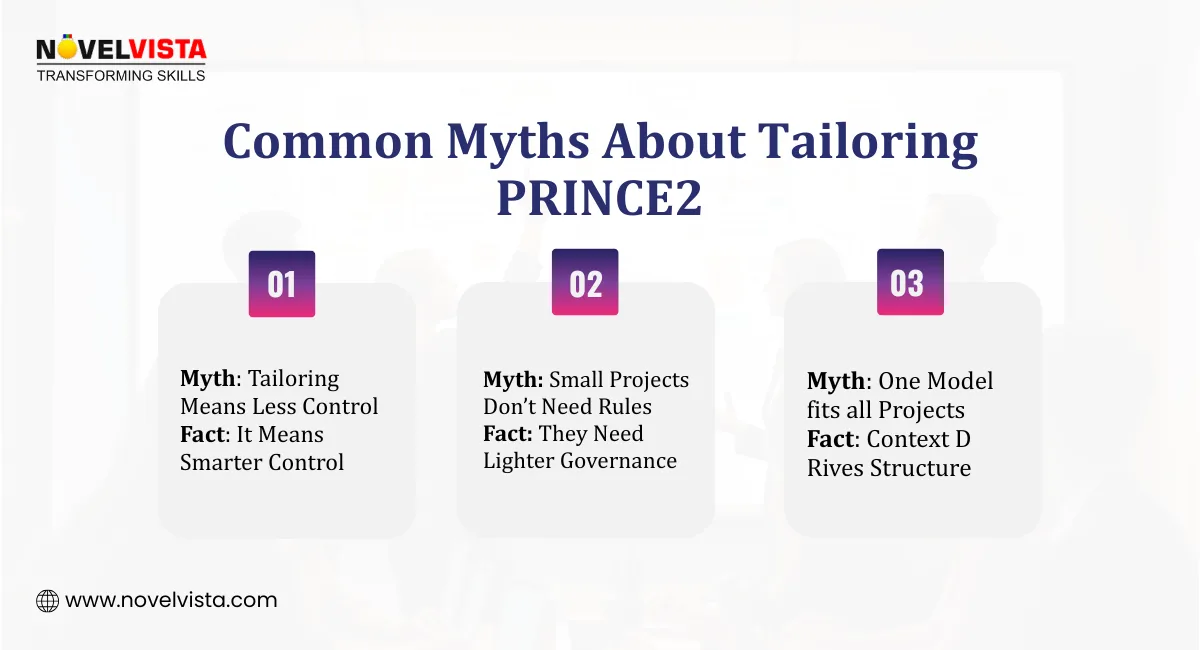
- Removing essential governance elements
- Oversimplifying to the point of losing accountability
- Over-documenting when unnecessary
- Forgetting to update tailoring decisions as the project evolves
- Ignoring stakeholder needs
It must be intentional, planned, and regularly reviewed.
Step-by-Step Approach to Tailoring PRINCE2 for Any Project
Follow these steps for a practical, repeatable tailoring strategy:
Understand the Project Context
Begin by defining the project context, including objectives, constraints, and the operating environment. This ensures Tailoring PRINCE2 is aligned with real business needs rather than assumptions.
Assess Governance Requirements
Identify the governance requirements that must remain in place to meet organizational, regulatory, and stakeholder expectations. This step ensures essential controls are preserved while allowing flexibility elsewhere.
Tailor Themes and Processes
Adjust PRINCE2 themes and processes by scaling documentation, roles, and workflows. The aim is to keep the method practical, proportionate, and fit for the project’s size and complexity.
Review Tailoring Decisions with the Project Board
Validate all tailoring decisions with the Project Board to confirm accountability and decision-making authority remain clear. This safeguards strong governance even when processes are streamlined.
Continuously monitor the effectiveness of tailoring as the project evolves. Tailoring PRINCE2 is not a one-time activity and should adapt to changing risks, priorities, and conditions. Alongside mastering tailoring concepts, knowing the PRINCE2 Certification Cost allows you to prepare for certification with clear expectations.
Conclusion
In today’s fast-moving business landscape, no single approach fits every project. Tailoring PRINCE2 empowers teams to maintain structure while staying flexible enough to adapt to different industries, team sizes, technologies, and risk profiles.
The key is balance:
Customize your processes, but never compromise governance.
With clear objectives, the right governance model, smart risk management, regular reviews, and meaningful KPIs, any organization can tailor PRINCE2 to deliver predictable, measurable, and high-quality outcomes—every time.
Ready to master Tailoring PRINCE2 and strengthen your project governance?
Join NovelVista’s PRINCE2 Foundation & Practitioner Certification and gain practical skills to tailor PRINCE2 for any project, apply strong governance, and deliver predictable, high-quality outcomes. Designed for project managers, PMO leads, and IT delivery professionals, this course equips you to adapt processes, manage risks effectively, and lead projects confidently in any environment.
Start your PRINCE2 certification journey today!

Frequently Asked Questions
Author Details

Course Related To This blog
PRINCE2 Agile® Foundation
PRINCE2 Agile® Foundation & Practitioner
PRINCE2® Foundation & Practitioner
PRINCE2® Foundation
PRINCE2® Practitioner
PRINCE2 Agile® Practitioner
Confused About Certification?
Get Free Consultation Call