- A Quick Overview of ITIL Versions
- ITIL v3 vs ITIL 4: The Core Philosophical Shift
- Structural Differences: ITIL v3 vs ITIL 4 Explained
- Practical Differences for Modern IT Teams
- Certification Comparison: ITIL Foundation 3 vs ITIL 4
- ITIL v3 vs ITIL 4 vs ITIL (Version 5)
- Should You Move from ITIL v3 to ITIL 4?
- The Future of ITSM: Where ITIL 4 and ITIL (Version 5) Are Heading
- Conclusion
IT downtime is no longer just an inconvenience, it's a measurable business risk. Studies estimate that unplanned IT outages can cost organizations thousands of dollars per minute, while global enterprises lose millions annually due to inefficient service management. Despite this, a surprising number of organizations still rely on legacy IT service management practices designed for a very different era of IT.
That’s where the debate around ITIL v3 vs ITIL 4 becomes critical.
Many IT teams today are caught in the middle: legacy systems built on ITIL version 3, new cloud-native services demanding agility, and growing curiosity around what comes next with ITIL (Version 5). If you’ve ever asked yourself “Is ITIL v3 still relevant?”, “What’s actually different in ITIL 4?”, or “Do I need to upgrade my ITIL certification?” you’re not alone.
This blog breaks down ITIL v3 vs ITIL 4 vs ITIL (Version 5) in a practical way. The main focus stays firmly on ITIL v3 vs ITIL 4, helping modern IT teams understand what changed, why it matters, and what to do next.
A Quick Overview of ITIL Versions
Before diving deep into ITIL v3 vs ITIL 4, let’s set the context.
What is ITIL v3?
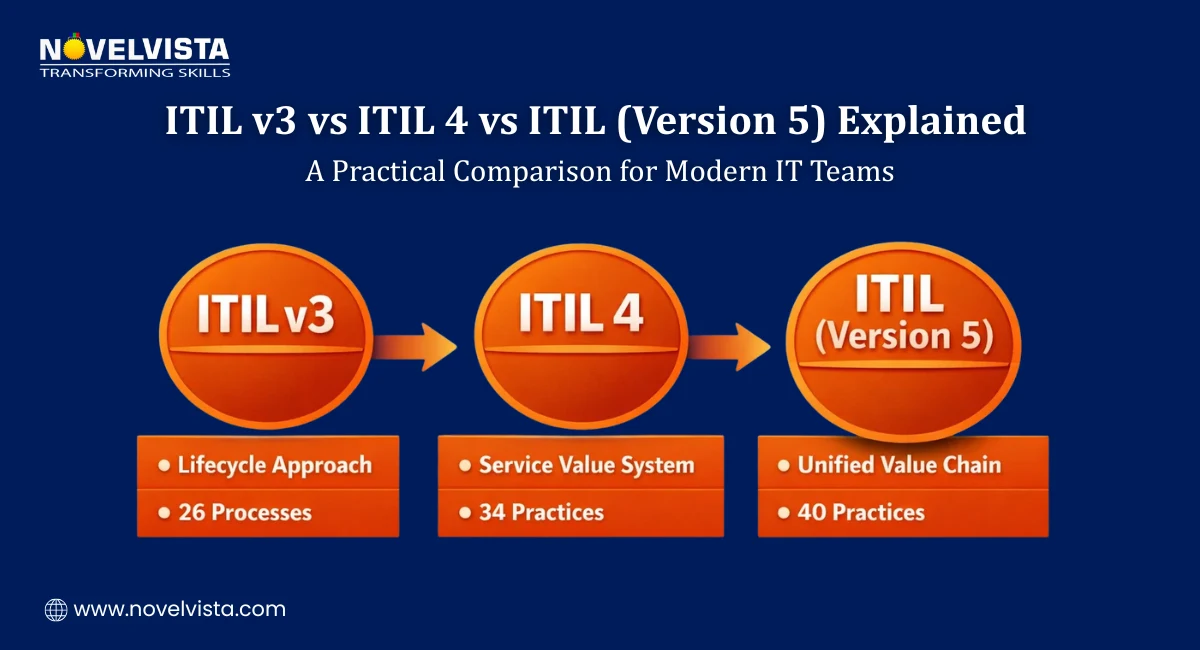
ITIL v3 (released in 2007 and updated in 2011) is a widely adopted IT service management framework built around a service lifecycle model. It focuses on delivering stable, consistent, and predictable IT services through clearly defined and well-documented processes. The ITIL v3 service lifecycle is structured across five key stages: Service Strategy, Service Design, Service Transition, Service Operation, and Continual Service Improvement, each designed to manage services from planning to ongoing optimization. By emphasizing control, standardization, and best practices, ITIL v3 brought much-needed structure and maturity to ITSM. However, as IT environments became faster, more digital, and more Agile, the process-heavy nature of ITIL v3 increasingly emerged as a limitation for modern IT teams.
What Is ITIL 4?
ITIL 4, released in 2019, represents a major shift. Instead of rigid lifecycles, it introduces a value-driven, flexible framework designed for modern digital organizations.
At its core is the Service Value System (SVS), which focuses on co-creating value with stakeholders. ITIL 4 embraces Agile, DevOps, Lean, and cloud-native ways of working.
Where Does ITIL (Version 5) Fit In?
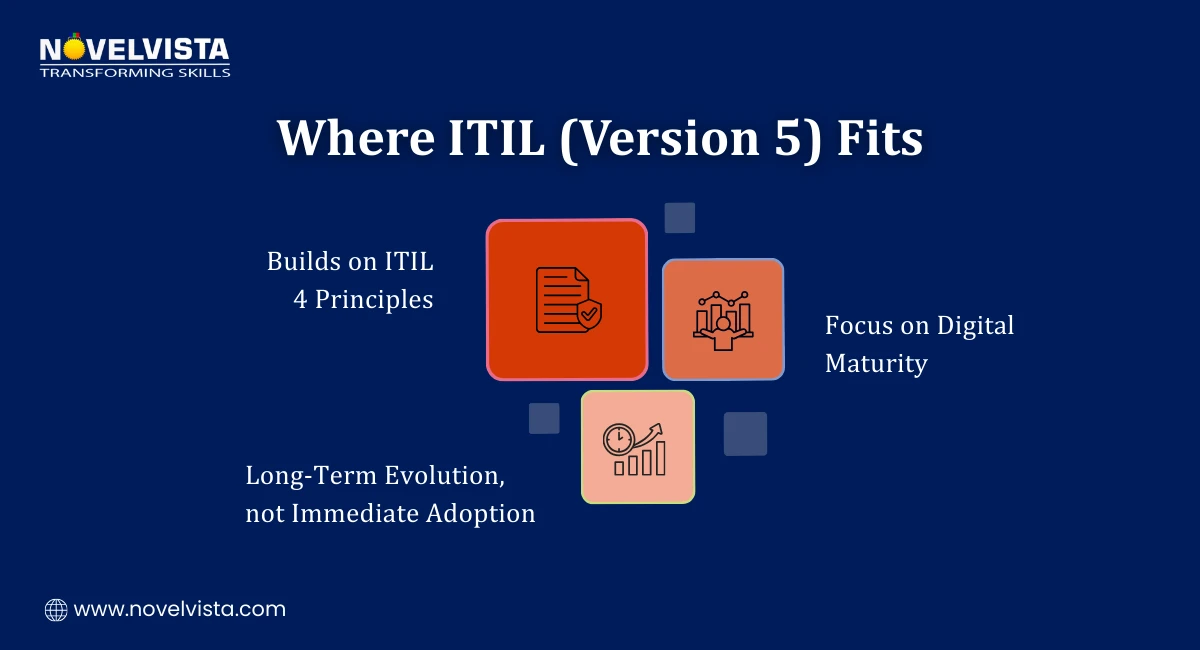
ITIL (Version 5) is positioned as an evolutionary direction, not a replacement. It builds on ITIL 4 concepts, with more emphasis on digital transformation, sustainability, and organizational resilience. For now, ITIL 4 remains the dominant and practical standard.
ITIL v3 vs ITIL 4: The Core Philosophical Shift
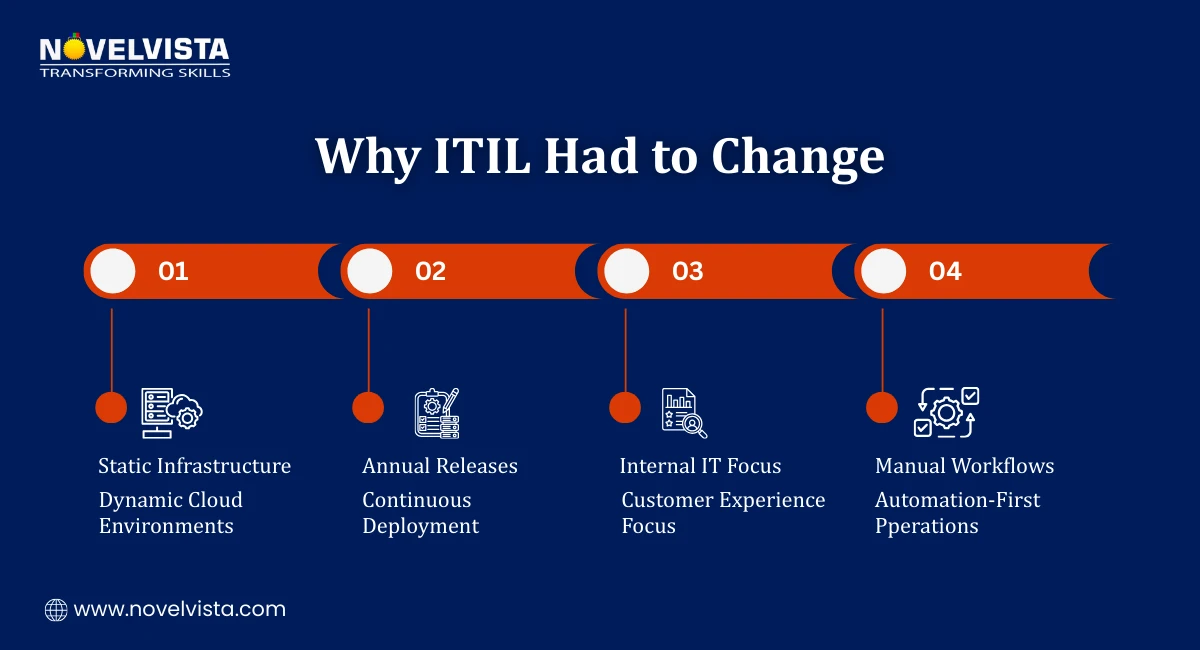
The biggest difference in ITIL v3 vs ITIL 4 is not the terminology or structure it’s the mindset behind how IT services are delivered. ITIL v3 is centered on process compliance and control, with a strong emphasis on standardizing IT services, minimizing risk, and ensuring operational stability. In contrast, ITIL 4 shifts the focus to value creation and business outcomes, encouraging organizations to deliver what customers actually need, while enabling faster, more flexible, and more efficient service delivery aligned with modern digital environments.
In simple terms:
- ITIL v3 asks: “Are we following the process?”
- ITIL 4 asks: “Are we delivering value?”
This shift explains why many organizations found ITIL v3 difficult to align with Agile and DevOps practices, while ITIL 4 fits naturally into modern IT ecosystems.
Structural Differences: ITIL v3 vs ITIL 4 Explained
Lifecycle vs Service Value System
In ITIL version 3 vs 4, structure is one of the most significant differentiators in how services are designed and delivered. ITIL v3 follows a linear service lifecycle, where work progresses step by step through defined stages, often resulting in sequential handoffs and limited flexibility. In contrast, ITIL 4 introduces the Service Value System (SVS), a dynamic model that supports continuous feedback, iteration, and ongoing improvement. The Service Value System reflects how modern IT teams actually operate today non-linear, highly collaborative, and fast-moving making ITIL 4 far better suited for today’s digital and Agile-driven environments.
Processes vs Practices
Another key change in ITIL 3 vs ITIL 4 is the move from processes to practices.
- ITIL v3 defines 26 processes, often implemented rigidly.
- ITIL 4 defines 34 practices, designed to be adaptable to organizational context.
Practices allow teams to apply guidance flexibly instead of forcing one-size-fits-all workflows.
Roles and Collaboration
When it comes to roles and collaboration, the difference between ITIL v3 vs ITIL 4 is clearly visible in how teams are structured and work together. ITIL v3 often resulted in siloed roles, with separate incident teams, change teams, and release teams operating independently. This separation frequently slowed communication and decision-making. In contrast, ITIL 4 promotes cross-functional collaboration, encouraging shared ownership across teams and focusing on end-to-end value streams that improve coordination, speed, and overall service outcomes. ITIL concepts focus on delivering value through efficient service management by aligning people, processes, partners, and technology to support business outcomes.
Practical Differences for Modern IT Teams
When comparing ITIL 4 vs ITIL v3, the real impact shows up in day-to-day operations.
Change Management vs Change Enablement
- ITIL v3 focuses on minimizing risk, often slowing innovation.
- ITIL 4 emphasizes enabling change safely and quickly.
Incident and Problem Management
- ITIL v3 prioritizes restoration and root cause analysis.
- ITIL 4 integrates automation, monitoring, and continual improvement.
Agile, DevOps, and Cloud Alignment
- ITIL v3 struggles to align with CI/CD pipelines.
- ITIL 4 is designed to coexist with Agile sprints and DevOps workflows.
For modern IT teams, this makes ITIL v3 vs ITIL 4 less about theory and more about operational efficiency.
Certification Comparison: ITIL Foundation 3 vs ITIL 4
For learners, ITIL Foundation v3 vs 4 is a common question.
- ITIL Foundation v3 focuses on lifecycle stages and processes.
- ITIL 4 Foundation emphasizes concepts like value streams, practices, and guiding principles.
From a career perspective, ITIL 4 Foundation is more aligned with today’s job roles, especially in cloud, DevOps, and digital transformation initiatives.
Free Download: The Practical ITIL Evolution Guide
- Understand ITIL’s evolution from ITIL 4 to ITIL (Version 5)
- Learn value-driven ITSM essentials for modern teams
- Align ITIL with Agile, DevOps, and digital services
ITIL v3 vs ITIL 4 vs ITIL (Version 5)
Aspect |
ITIL v3 |
ITIL 4 |
ITIL (Version 5) |
Core Philosophy |
Process-centric |
Value-centric |
Value + sustainability |
Framework Structure |
Service Lifecycle |
Service Value System |
Evolution of SVS |
Flexibility |
Low to moderate |
High |
Very high |
Agile & DevOps Alignment |
Limited |
Strong |
Stronger |
Certification Relevance |
Declining |
Current standard |
Emerging |
Best For |
Traditional IT ops |
Modern IT teams |
Future-ready orgs |
Should You Move from ITIL v3 to ITIL 4?
Staying with ITIL v3 may still work if:
- Your environment is stable and highly regulated
- Change frequency is low
However, upgrading makes sense if:
- You’re adopting Agile, DevOps, or cloud platforms
- Speed and customer experience matter
- Teams feel constrained by rigid processes
For most organizations, the shift from ITIL v3 vs ITIL 4 is less about replacing everything and more about evolving intelligently.
The Future of ITSM: Where ITIL 4 and ITIL (Version 5) Are Heading
ITIL 4 is firmly established as the present standard for IT service management. ITIL (Version 5) builds on this foundation, signaling a future focused on adaptability, digital value, and sustainable practices. ITIL 4 vs ITIL (Version 5) highlights the shift from today’s value-driven IT service management framework to the future evolution focused on greater adaptability, sustainability, and digital maturity.
For now, mastering ITIL 4 is the most practical move for both organizations and professionals.
Conclusion
The comparison of ITIL v3 vs ITIL 4 clearly shows how IT service management has evolved from rigid, process-driven execution to flexible, value-focused delivery. While ITIL v3 established a strong and much-needed foundation for consistency and control, it was designed for a slower, more predictable IT landscape. ITIL 4 reflects how IT truly operates today fast, digital, collaborative, and deeply connected to business outcomes.
For modern IT teams, ITIL 4 is not just an upgrade to ITIL v3 it is a fundamental mindset shift toward value co-creation, adaptability, and continuous improvement. And while ITIL version 5 hints at the future direction of ITSM, the real-world relevance, practical adoption, and career impact all firmly sit with ITIL 4 right now. For organizations and professionals alike, understanding this shift is no longer optional it’s essential.
Ready to Strengthen Your ITIL (Version 5) Skills?
If you’re ready to move beyond theory and apply ITIL principles in real-world IT environments, NovelVista’s ITIL 4 Foundation Certification Training is a strong starting point, while the ITIL 5 Foundation program prepares you to understand the next evolution of IT service management and stay future-ready. Designed for IT professionals and modern IT teams, this course helps you understand value streams, ITIL 4 practices, and service management concepts aligned with Agile, DevOps, and cloud-based operations. With expert-led training, practical insights, and globally recognized certification, you’ll be well-equipped to lead IT service management initiatives with confidence in today’s fast-changing digital landscape.
Start your ITIL journey today!
Frequently Asked Questions
Author Details

Course Related To This blog
ITIL® 4 Strategic Leader Digital And IT Strategy (DITS)
ITIL® 4 Specialist Drive Stakeholder Value
ITIL® 4 Specialist High Velocity IT
ITIL® 4 Strategist Direct, Plan & Improve
ITIL® 4 Specialist Create Deliver & Support
ITIL® 4 Foundation Certification
ITIL V5 Foundation
Confused About Certification?
Get Free Consultation Call